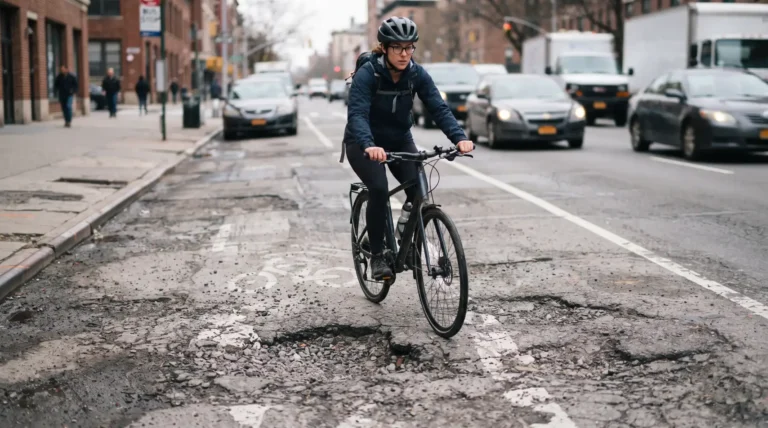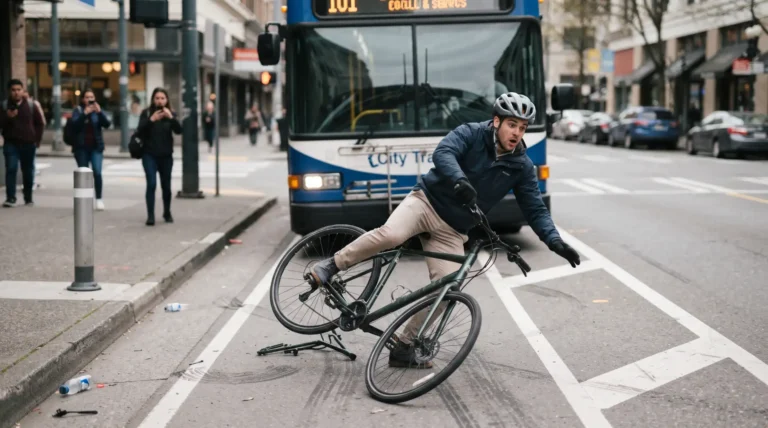
Automatic emergency braking has become one of the most important collision-avoidance technologies in modern passenger vehicles. Cameras, radar, software, and other sensors can monitor the roadway ahead and, when the system determines that a collision is imminent, warn the driver or automatically apply the brakes.
For cyclists, that technology has enormous potential. A vehicle that recognizes a bicyclist even a fraction of a second earlier may reduce its speed before impact or, in favorable circumstances, avoid the collision altogether.
But automatic emergency braking, commonly called AEB, should not be confused with a guarantee that a vehicle will recognize every cyclist in every situation.
Research into cyclist-responsive AEB shows that performance can depend on the direction the bicycle is traveling, lighting, vehicle speed, positioning, and the specific system installed in the vehicle. The Insurance Institute for Highway Safety has reported that current systems tested in bicycle scenarios performed substantially better in some situations than others, particularly highlighting limitations when a vehicle approaches a bicycle from behind at night with low-beam headlights.
That creates an increasingly important question after modern bicycle crashes: what happens when a vehicle equipped with sophisticated collision-avoidance technology fails to detect the cyclist?
The answer can involve much more than simply asking whether the AEB system activated. Investigators may need to examine driver behavior, roadway conditions, vehicle data, sensor performance, maintenance history, software, warnings issued before the crash, and potentially whether a product defect contributed to the collision.
What Is Automatic Emergency Braking?
Automatic emergency braking is an advanced driver assistance feature intended to help avoid certain collisions or reduce their severity. NHTSA describes AEB as technology that automatically applies a vehicle’s brakes when a forward collision is imminent.
Many systems work together with forward collision warning. Sensors continuously monitor what is happening ahead of the vehicle. When software determines that the closing distance or trajectory presents a collision risk, the system may first alert the driver. If the driver does not react quickly enough, an automatic braking intervention may follow.
Depending on the vehicle, the detection system may rely on cameras, radar, lidar, or combinations of sensors.
These systems are useful, but they remain driver-assistance technologies. NHTSA specifically places automatic emergency braking among technologies in which the human driver remains responsible for operating and monitoring the vehicle. AEB does not turn an ordinary passenger vehicle into a self-driving car.
That distinction becomes especially important in bicycle crashes. A motorist generally cannot justify failing to observe a cyclist simply by saying that the vehicle’s safety technology also failed to recognize the rider.
Why Detecting a Cyclist Can Be Difficult
Recognizing another automobile is relatively straightforward compared with identifying vulnerable road users in complex environments.
Cars generally have large, predictable profiles. Bicycles and riders present smaller and more variable shapes. They may travel near the edge of the roadway, cross perpendicular to traffic, ride between shadows and sunlight, enter an intersection from a bike lane, or travel alongside a vehicle before suddenly appearing in its projected path.
A cyclist’s movement is also different from that of a pedestrian or another car. The bicycle can move quickly enough to change position substantially within only a few seconds while remaining significantly smaller than a motor vehicle.
The system must therefore do more than recognize the existence of an object. It must classify the object correctly, determine its direction and speed, calculate whether its path will intersect with the vehicle, and decide whether braking is necessary.
All of that must happen extremely quickly.
Nighttime Riding Can Create Additional Challenges
Lighting is one of the most significant concerns surrounding cyclist-detection performance.
In a 2025 study examining AEB systems designed to respond to bicyclists, IIHS researchers found that the tested systems mitigated bicycle crashes in several daytime crossing and parallel-path scenarios. Performance was considerably weaker in a nighttime scenario in which the vehicle approached the bicycle from behind while using low beams.
That finding matters because nighttime crashes can already be dangerous for cyclists.
Vehicle cameras depend heavily on their ability to distinguish a rider from the surrounding environment. Darkness, glare, shadows, insufficient roadway lighting, weather, headlights from other vehicles, and visual clutter can make the task more difficult.
Radar may help supplement camera information, but the way each manufacturer combines and interprets sensor data varies.
A properly functioning headlight system and adequate cyclist visibility can improve conditions, but motorists must still drive appropriately for conditions and maintain a reasonable lookout. Driver-assistance technology is an additional layer of crash prevention, not a substitute for attentive driving.
Crossing-Path Bicycle Crashes
Another challenging situation occurs when the bicycle and vehicle are not traveling in exactly the same direction.
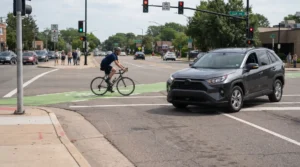
Imagine a cyclist proceeding through an intersection while an approaching vehicle begins a turn. The bicycle may initially be beside the vehicle rather than directly ahead of it. Only as the vehicle turns do the two trajectories begin to intersect.
The detection system must predict that developing conflict.
These situations include familiar bicycle crash patterns such as motorists turning across bicycle lanes, vehicles entering intersections while cyclists are crossing, and drivers emerging from driveways or side streets.
The cyclist may be clearly visible to a human driver who checks the roadway properly, even if the vehicle’s automated system does not classify the situation as dangerous early enough to intervene.
For that reason, a failure of AEB does not automatically resolve the underlying negligence question.
Approaching a Cyclist From Behind
Rear-approach crashes are particularly important because the cyclist may have little or no opportunity to react.
A rider traveling in the same direction as traffic may not see the vehicle approaching. Even when the cyclist hears it, there may be nowhere safe to move.
An AEB system facing this scenario must recognize a relatively narrow road user directly or partially ahead of the vehicle and determine whether the motorist will pass safely or collide with the bicycle.
Lane placement can complicate that calculation. A cyclist may ride near the fog line, within a bicycle lane, or partly inside a general traffic lane because of parked cars, debris, pavement damage, construction, or other hazards.
The software must distinguish between a vehicle safely passing the cyclist and a rapidly developing collision.
IIHS’s research suggests that improving performance across both crossing-path and parallel-path bicycle scenarios could have substantial safety benefits. Researchers estimated that a consistently effective bicycle-responsive AEB system could potentially address approximately 28,600 police-reported bicycle crashes and about 600 fatal bicycle crashes each year.
Does Federal Law Require AEB to Detect Bicyclists?
This point requires careful distinction.
NHTSA finalized Federal Motor Vehicle Safety Standard No. 127 to require automatic emergency braking on covered new passenger vehicles and light trucks, including pedestrian automatic emergency braking. The rule’s performance requirements include pedestrian detection during daylight and darkness, with the general compliance deadline set for September 1, 2029.
However, bicycle detection is not the same thing as the pedestrian-detection requirement.
NHTSA has separately researched how AEB systems respond to bicycles and motorcycles. Agency testing has found that factors such as lighting, speed, lane position, and the presence of other vehicles can influence system performance.
Consumers should therefore avoid assuming that a vehicle advertised as having automatic emergency braking or pedestrian detection necessarily provides equivalent protection in every cyclist scenario.
The exact capabilities depend on the vehicle, model year, hardware, software, operating conditions, and manufacturer specifications.
The Driver May Still Be Responsible
A common misconception is that increasingly automated vehicles transfer responsibility away from drivers.
For ordinary driver-assistance systems, they generally do not.
AEB may assist when a driver fails to react quickly enough, but the person behind the wheel is still expected to observe traffic, obey applicable traffic laws, maintain control of the vehicle, and respond to cyclists sharing or crossing the roadway.
Suppose a driver looks down at a phone while approaching a cyclist. If the vehicle’s automatic braking also fails to activate, the existence of AEB does not erase the driver’s conduct.
Similarly, a motorist may make an unsafe turn across a bicycle lane despite having a vehicle equipped with cyclist-detection technology. Liability can still center on whether the driver’s actions were reasonable under the circumstances.
Because traffic and negligence rules vary by state, the precise legal analysis depends on where the crash occurs.
Could the Vehicle Manufacturer Be Responsible?
Some bicycle crashes involving failed safety technology raise a different issue: whether there was something wrong with the vehicle or its safety system.
A product-liability investigation may become relevant when evidence suggests that the system failed because of a defective sensor, faulty component, software problem, manufacturing defect, inadequate warning, or another problem with the vehicle.
That does not mean every unsuccessful AEB intervention creates a claim against the automaker.
AEB systems have defined operating limitations. A system may have been functioning exactly as designed yet not have been designed to intervene in the particular circumstances involved in the collision.
The key question is often why the system failed to respond.
Answering it can require considerably more technical evidence than a traditional bicycle accident investigation.
Sensor Damage, Obstruction, and Maintenance
Modern driver-assistance systems depend on sensors being able to see or measure the environment correctly.
Cameras may be located near the windshield. Radar units can be integrated into the front grille, bumper, or other parts of the vehicle. Their location varies among manufacturers.
Damage or obstruction may affect performance.
A prior collision, windshield replacement, bumper repair, sensor misalignment, improper calibration, dirt, snow, ice, or other conditions can potentially interfere with certain systems. The vehicle’s owner’s manual may describe circumstances in which a particular feature has limited functionality.
This makes the vehicle’s repair history potentially relevant after a serious cyclist crash.
If the front bumper was repaired shortly before the collision, for example, investigators may want to determine whether radar components were removed, replaced, or calibrated.
Likewise, a windshield replacement could matter when an AEB system relies on a forward-facing camera mounted near the glass.
Software and Electronic Data May Become Important Evidence
A modern bicycle collision can generate digital evidence that did not exist in older vehicles.
Depending on the vehicle and circumstances, relevant evidence may include diagnostic information, event data recorder information, driver-assistance warnings, fault codes, sensor records, software version information, service records, and data maintained by the manufacturer or another entity.
Not every vehicle records the same information, and not every type of data will be available after every collision.
That is why preservation can matter.
If a vehicle is repaired, sold, destroyed, updated, or returned to service before the relevant systems are examined, potentially useful evidence may become harder to obtain.
Cyclists involved in serious crashes should also preserve their own evidence whenever possible. Bicycle computers, fitness applications, GPS devices, action cameras, smartphones, and connected e-bike systems may contain information about speed, route, timing, and location.
Readers can also review the site’s How to Gather Evidence After a Bicycle Accident guide for broader information about preserving photographs, witness information, records, and other crash evidence.
How Investigators Determine Whether AEB Activated
After a severe collision, simply looking at the damaged car usually will not reveal whether automatic emergency braking worked properly.
An investigation may begin by establishing the exact make, model, trim, model year, and equipment package of the vehicle. Investigators must determine what safety system the vehicle actually had rather than relying on general advertising for the model.
They may then examine whether the feature was active, whether any warning appeared before impact, whether the system recorded a fault, whether braking occurred before the collision, and whether the driver also attempted to brake.
Physical evidence remains important.
Tire marks, debris, bicycle damage, vehicle damage, road markings, surveillance footage, dashcam video, intersection cameras, witness accounts, and final resting positions can help reconstruct how the collision developed.
Digital evidence can then be compared with the physical reconstruction.
AEB Failure Does Not Automatically Prove a Defect
This is an important legal and technical distinction.
If an AEB-equipped vehicle hits a cyclist without braking automatically, it does not necessarily mean the system was defective.
The circumstances may have fallen outside the system’s capabilities. The system may have detected the cyclist but concluded that braking was unnecessary until too late. The driver may have overridden an intervention. Environmental conditions may have reduced sensor performance.
Alternatively, there may actually have been a malfunction.
Investigators should avoid assuming the answer in either direction.
The purpose of collecting evidence is to determine what happened rather than starting with the conclusion that either the driver or vehicle technology must be responsible.
Readers interested in the broader liability process can also review How to Prove Liability in a Bicycle Accident Case, which discusses evidence commonly used to establish responsibility after a cycling collision.
What Happens When Both Driver Error and Technology Are Involved?
Some crashes do not have a single cause.
A distracted driver might fail to notice a cyclist at the same time that an automatic braking system fails to intervene. A vehicle sensor may have been improperly calibrated after repairs while the driver was also traveling too fast for conditions.
These overlapping causes can complicate a claim.
Depending on state law and the evidence, responsibility could potentially involve multiple parties, including the driver, vehicle owner, employer, repair facility, component supplier, manufacturer, or another entity.
Comparative-fault rules also differ around the United States. A cyclist’s conduct may be examined as part of the investigation, but an allegation against the rider does not automatically establish fault.
Because bicycle laws vary significantly from state to state, readers should consult the site’s Understanding Bicycle Accident Laws in Your State resource when researching local rules.
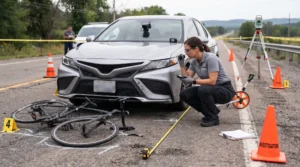
What Evidence Should Be Preserved After an AEB-Related Bicycle Crash?
Technology-related bicycle crashes require traditional evidence and technical evidence to be considered together.
Photographs of the vehicle should capture more than visible impact damage. The windshield, front grille, bumper, cameras, radar areas, dashboard warnings, and other relevant components may also be important.
The exact vehicle identification number can help determine equipment and recall information.
Police reports, witness statements, surveillance footage, dashcam recordings, traffic-camera footage, repair invoices, maintenance records, dealership records, and prior collision records can also become relevant.
When serious injuries are involved, obtaining evidence quickly can be important because vehicles are often repaired and electronic information may not remain available indefinitely.
The National Highway Traffic Safety Administration is a particularly useful authoritative resource for consumers researching driver-assistance technologies, vehicle recalls, safety ratings, and federal vehicle standards. NHTSA describes AEB as an assistive crash-avoidance technology rather than a replacement for driver attention.
Why AEB Evidence Can Matter in a Bicycle Accident Claim
Understanding whether automatic braking activated can help reconstruct the seconds immediately before impact.
Suppose vehicle data shows that the driver never applied the brakes but an emergency braking intervention began shortly before the collision. That information may help establish when the system recognized the danger and how much time was available.
A different vehicle might show no AEB intervention at all.
Investigators would then want to know whether the cyclist was outside the system’s detection capabilities, whether a technical problem existed, or whether other circumstances prevented activation.
This information can also help evaluate speed.
Even when AEB cannot prevent a crash entirely, reducing vehicle speed before impact may reduce collision severity. Conversely, evidence that there was no meaningful speed reduction can become important when reconstructing the force of the crash.
Automatic Braking Should Be a Safety Layer, Not the Only Safety Layer
The broader lesson from current research is not that automatic emergency braking is ineffective.
Quite the opposite.
Crash-avoidance technology has demonstrated significant real-world benefits. IIHS reports substantial reductions in front-to-rear crashes associated with AEB, while pedestrian-detecting AEB has also been associated with lower pedestrian crash and injury rates.
The issue is that safety systems have limits.
A cyclist cannot know whether an approaching car’s cameras can see them, whether its radar is calibrated correctly, whether its software recognizes the developing conflict, or whether the driver has disabled or ignored part of the system.
Drivers must therefore continue to treat cyclists as roadway users who require direct human attention.
Roadway design matters as well. Protected bicycle infrastructure, safe intersection design, appropriate speeds, adequate lighting, visibility improvements, and attentive driving all provide layers of protection that do not depend on a single piece of technology working perfectly.
Cyclist Detection Is Likely to Become More Important
Vehicle safety technology is developing rapidly, and vulnerable-road-user detection is becoming an increasingly important area of research.
NHTSA has evaluated AEB responses to two-wheel road users, including bicycles and motorcycles, while IIHS research has examined how systems perform in common bicycle crash configurations.
As these systems improve, cyclists may benefit from vehicles that can recognize them in a broader range of circumstances, including darkness, turning situations, crossing paths, and rear approaches.
Better technology, however, creates new questions after crashes.
What did the vehicle detect?
When did it detect the rider?
Was a warning issued?
Did automatic braking activate?
Was the system functioning correctly?
Had the sensors been properly maintained and calibrated?
Was the driver paying attention?
Those questions are increasingly becoming part of modern bicycle accident investigations.
Final Thoughts
Automatic emergency braking has the potential to prevent bicycle collisions and reduce the severity of crashes that cannot be avoided. But current technology should not be treated as an invisible safety shield around every cyclist.
Cyclist detection can be affected by lighting, speed, positioning, roadway geometry, the cyclist’s direction of travel, sensor performance, and the design of the specific vehicle system. Research has particularly highlighted challenges in certain nighttime rear-approach scenarios.
When a cyclist is struck by an AEB-equipped vehicle, the investigation should therefore look beyond the simple question of whether the car had automatic braking.
Driver behavior remains central. At the same time, vehicle data, sensor condition, maintenance history, system warnings, software, physical evidence, and the design of the technology may help explain why the crash occurred.
As automatic braking becomes increasingly common on U.S. roads, understanding its capabilities—and its limitations—will become an increasingly important part of protecting cyclists and determining responsibility after serious bicycle collisions.