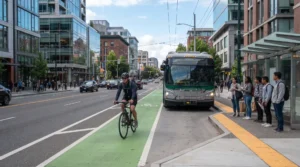
Bus stops are common features of American city streets, but they can also create complicated interactions between bicycles, buses, pedestrians, parked vehicles, and other traffic. A cyclist traveling through a bicycle lane may encounter a transit bus pulling toward the curb, leaving a stop, turning through an intersection, or moving back into traffic. At the same time, passengers may be crossing a bicycle lane to board or exit the bus.
When a bicycle and transit vehicle collide, the injuries can be serious and the question of responsibility is not always straightforward. A large bus has substantial weight and limited visibility compared with a bicycle, while the cyclist has little physical protection in a collision. Determining what happened may require an examination of traffic signals, roadway markings, bus movements, driver visibility, cyclist positioning, surveillance footage, witness statements, vehicle data, and applicable state or local laws.
The Federal Transit Administration has identified bus-to-person collisions involving pedestrians, bicyclists, and other micromobility users as an important transit safety issue. Its safety advisory identifies factors such as operator visibility limitations, obstructions outside the bus, people entering the bus path, and limited space around bus stops as potential hazards. Federal Transit Administration data also shows that bus-to-person collisions occur both at intersections and at or around bus stops.
For injured cyclists, understanding how these crashes happen and how liability may be evaluated can be an important first step. This article explains the common causes of bicycle accidents near bus stops, potentially responsible parties, evidence that may matter, insurance considerations, and legal issues that can arise when a public transit vehicle is involved.
Why Bus Stops Can Be Dangerous for Cyclists
A bus stop may appear to be a simple section of roadway where passengers wait for transportation. In reality, several different movements can occur within a relatively small space.
A bus may move from a travel lane toward the curb, stop to pick up passengers, remain stationary for several minutes, and then signal before merging back into traffic. Cyclists may be traveling alongside the bus during any of these movements. Pedestrians may simultaneously walk from the sidewalk toward the bus, cross a bicycle lane, or step around the front or rear of the vehicle.
These overlapping movements create potential conflict points.
The size of a transit bus can make the situation particularly challenging. A bus operator sits considerably higher than a cyclist and must monitor a large area around the vehicle. Mirrors and cameras can improve visibility, but they do not eliminate blind spots.
The Federal Transit Administration specifically identifies operator vision impairment and limited space around bus stops among the hazards that transit agencies should consider when assessing bus-to-person collision risks.
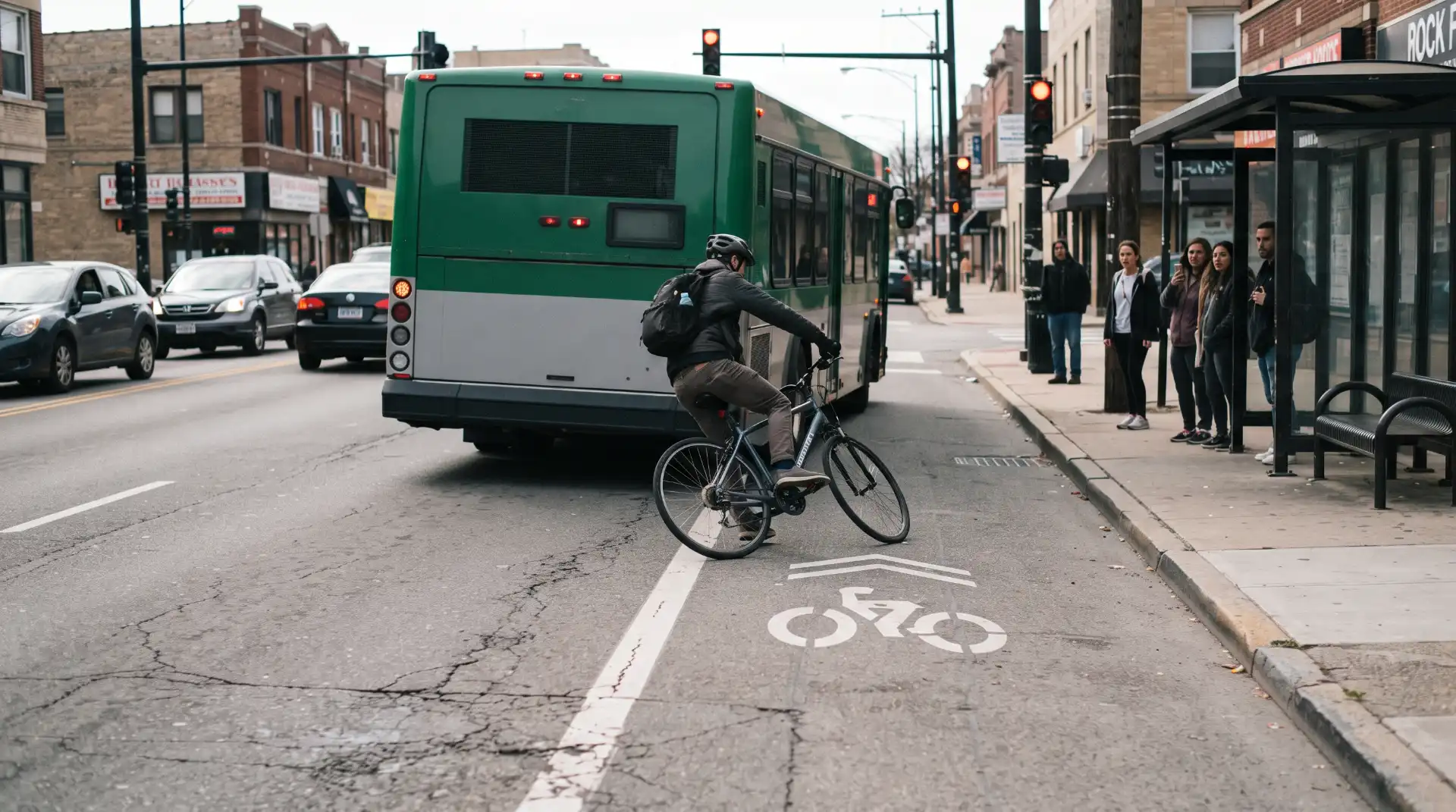
For cyclists, the danger may increase when a bicycle lane runs directly between moving traffic and a bus stop. A rider may have to pass close to a stationary bus, while the bus operator may be preparing to re-enter traffic. If the cyclist and bus occupy intersecting paths, even a brief failure to recognize the other road user can result in a collision.
Common Types of Bicycle and Bus Stop Collisions
Not every bicycle accident near a bus stop happens in the same way. The type of collision can affect what evidence investigators examine and which parties may potentially have responsibility.
A Bus Pulls Into the Cyclist’s Path
One common scenario occurs when a transit bus moves toward a curbside stop while a cyclist is traveling alongside the bus.
The cyclist may be continuing straight while the bus moves laterally toward the curb. If the bus crosses the cyclist’s path without sufficient clearance, the bicycle may strike the side of the bus or become trapped between the bus and another roadway feature.
The exact circumstances matter. Investigators may examine whether the bus operator used a turn signal, whether the cyclist was visible, how fast both parties were traveling, whether the bicycle lane was clearly marked, and whether the bus was required to yield under applicable traffic laws.
A Bus Leaves the Stop and Merges Into Traffic
Another common situation occurs when a bus has finished loading passengers and begins leaving the stop.
A cyclist may be approaching from behind or traveling alongside the bus. The bus may then move into a bicycle lane or another lane occupied by the cyclist.
This type of accident can produce significant injuries because the bicycle may be caught near the side or rear of a large vehicle.
The Federal Transit Administration’s data shows that bicyclists involved in mid-block bus-to-person collisions have experienced a substantial number of side-impact injuries and fatalities. The agency reported that, among bicyclist injuries and fatalities from mid-block collisions in the 2017–2021 data, 62 percent resulted from side impacts.
That statistic does not establish liability in an individual accident, but it demonstrates why interactions between buses and cyclists deserve careful safety analysis.
A Bus Turns Across a Bicycle’s Path
Bus stops are frequently located near intersections, which creates another potential danger.
A bus may approach an intersection, turn right, and cross the path of a cyclist traveling straight. The cyclist may have a green signal or otherwise believe that the path is clear, while the bus operator may be focused on pedestrians, vehicles, or the turning maneuver.
Left turns can also create conflicts depending on the roadway configuration.
The Federal Transit Administration has identified intersections as a major location for bus-to-person collisions. Its current safety advisory reports that 41 percent of bus-to-person collisions from 2017 through 2023 occurred at roadway intersections.
When a bicycle accident happens at an intersection near a bus stop, investigators may need to reconstruct the movements of everyone involved rather than focusing solely on the moment of impact.
A Cyclist Passes a Stopped Bus
Cyclists may sometimes pass a stopped bus when the bus is loading or unloading passengers.
This can be particularly hazardous because passengers may enter or leave the bus and cross the cyclist’s path. A cyclist traveling behind or beside a bus may also have limited visibility of people stepping into the roadway.
Similarly, the bus may block the cyclist from the view of other drivers.
The California Department of Transportation recognizes the importance of bicycle and transit connections and has published guidance addressing bicycle access to transit facilities. Caltrans also provides bicycle safety guidance emphasizing awareness of road hazards, traffic signals, vehicle movements, and proper positioning.
Who May Be Liable After a Bicycle-Bus Collision?
Liability depends on the specific facts and the law governing the accident location. There is no automatic rule that a bus driver is responsible simply because a bus is larger than a bicycle, and there is no automatic rule that a cyclist is responsible simply because the cyclist was traveling near the bus.
The investigation must determine what each person did and whether those actions contributed to the crash.
The Transit Bus Driver
A bus driver may potentially be liable when negligent conduct contributes to a collision.
Examples could include failing to check for cyclists before changing position, making an unsafe turn, failing to yield when required, following traffic too closely, speeding for conditions, or operating the vehicle while distracted.
Professional transit drivers generally receive specialized training because they operate large vehicles carrying passengers in environments with pedestrians, cyclists, and other vehicles.
However, the mere fact that a collision occurred does not establish negligence. Investigators may need to determine whether the driver had a reasonable opportunity to see the cyclist, whether the cyclist was in an expected location, whether visibility was obstructed, and whether the driver followed applicable traffic rules and transit procedures.
The Transit Agency
A public transit agency may potentially become involved in a claim depending on its ownership of the vehicle, employment relationship with the driver, maintenance responsibilities, or other circumstances.
For example, an accident involving a city-operated bus may raise different procedural issues from a collision involving a privately operated shuttle or contracted transportation service.
Claims against public entities can also involve special legal requirements. Deadlines, notice requirements, immunity rules, and available remedies vary depending on the jurisdiction and circumstances.
For that reason, an injured cyclist should not assume that a claim against a transit agency follows exactly the same process as an ordinary claim against a private motorist.
The Cyclist
Cyclists also have responsibilities under applicable traffic laws.
A rider could potentially contribute to a collision by traveling against traffic, ignoring a traffic signal, riding unpredictably, entering a prohibited area, passing a bus in an unsafe manner, or failing to yield when required.
However, an allegation that a cyclist made a mistake does not automatically resolve liability.
Many bicycle crashes involve multiple contributing factors. The cyclist’s actions, the bus driver’s actions, roadway design, traffic signals, visibility, and other circumstances may all need to be considered.
Depending on the state, comparative negligence or another allocation-of-fault system may affect the amount of compensation available.
A Government Agency or Roadway Authority
Roadway design can also matter.
A bus stop may be positioned directly next to a bicycle lane, leaving cyclists and buses to share a narrow space. Poor visibility, faded lane markings, inadequate lighting, confusing signs, damaged pavement, or an unusual intersection design may contribute to a crash.
That does not mean the government agency responsible for the roadway is automatically liable. A successful claim generally requires a legal basis for responsibility and evidence connecting the roadway condition to the accident.
Claims involving public entities can also have special procedural rules.
California and other states have different requirements concerning claims against public agencies, so these cases should be evaluated under the law applicable to the location of the accident.
Bus Stop Design Can Affect Bicycle Safety
The design of a bus stop can have a major influence on how cyclists and buses interact.
Traditional curbside bus stops may place a bicycle lane between the travel lane and the passenger boarding area. When a bus stops, it may cross the bicycle lane to reach the curb. Cyclists may then have to travel around or behind the bus.
Another approach is the use of a bus boarding island, sometimes called a floating bus stop.
Caltrans describes bus boarding islands as locations where the passenger boarding platform is separated from the sidewalk by a bicycle lane. The bicycle lane runs behind the bus stop, helping reduce conflicts between bicycles and buses pulling into the stop and reducing the chance that a cyclist will remain in the bus operator’s blind spot.
These design differences can become important after a collision.
If a crash occurs at a location where bicycle and transit movements were poorly separated, photographs and measurements of the roadway may help explain how the accident developed.
The Federal Transit Administration also provides a manual focused specifically on pedestrian and bicycle connections to transit, including methods for evaluating and improving bicycle and pedestrian access around transit facilities.
Why Intersections Near Bus Stops Require Extra Attention
A bus stop located close to an intersection can create multiple simultaneous movements.
A cyclist may be proceeding through an intersection while a bus is turning. Pedestrians may be crossing in a crosswalk. Other vehicles may be changing lanes. Passengers may be boarding or leaving the bus.
The resulting environment can make it difficult to determine what happened based solely on statements from the people involved.
Traffic signals can become particularly important.
Investigators may need to determine which signal each road user had, whether the signal changed during the incident, whether a pedestrian signal was active, and whether the bus was turning under a permitted movement.
Video evidence can be especially valuable in these circumstances.
Traffic cameras, nearby business surveillance systems, transit vehicle cameras, helmet cameras, dashcams, and smartphone recordings may provide different views of the same event.
Evidence That Can Help Investigate a Bicycle-Bus Accident
Evidence is often critical because bicycle-bus collisions can happen quickly and may produce conflicting accounts.
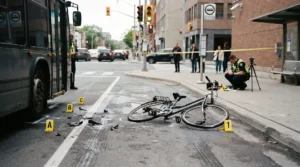
Photographs of the accident scene can document lane markings, traffic signals, bus stop signs, curb locations, bicycle infrastructure, road conditions, visibility, and the final positions of the bicycle and bus.
Video footage can be even more useful when available.
A transit bus may have exterior or interior cameras, depending on the agency and vehicle. Nearby businesses may also have surveillance cameras that capture the roadway. Traffic-management systems can sometimes provide additional information.
The preservation of this type of evidence can be time-sensitive because surveillance systems may automatically overwrite older recordings.
Your existing article on Can Helmet-Camera Footage Prove a Bicycle Accident Claim? provides additional information about how rider-generated video may help document a collision.
Witness statements can also be important.
A person waiting at a bus stop may have seen the bus approach the curb. Another person may have observed the cyclist traveling through the intersection. A driver behind the bus may have seen whether a turn signal was activated.
Independent witnesses can sometimes provide information that is not available from the people directly involved in the crash.
Transit Records May Become Important
A transit vehicle can generate records that are potentially relevant to an accident investigation.
Depending on the transit system, records may include vehicle location data, route information, dispatch records, onboard camera footage, operator reports, maintenance records, or other operational information.
The availability and retention period for these records varies.
If a collision involves a public transit agency, an injured cyclist may need to follow applicable legal procedures to obtain records. The process can be different from obtaining evidence from a private driver.
This is another reason that preserving information promptly can matter.
An investigation may need to establish not only where the bus was but also what the bus was doing immediately before the collision.
Medical Documentation After a Bicycle-Bus Collision
Medical documentation is another important part of a bicycle accident claim.
A collision with a transit bus can cause severe injuries because of the difference in size and weight between the vehicles. Cyclists may suffer fractures, traumatic brain injuries, spinal injuries, internal injuries, road rash, nerve damage, or soft-tissue injuries.
Some injuries are immediately obvious, while others may become apparent later.
Medical professionals can evaluate symptoms and determine whether additional treatment is necessary.
Medical records can also help establish the connection between the collision and the injuries being claimed.
For serious injuries, documentation may include emergency treatment, hospitalization, surgery, physical therapy, rehabilitation, diagnostic imaging, prescriptions, specialist appointments, and future treatment recommendations.
An injured cyclist should follow medical instructions and keep records of treatment and related expenses.
Insurance Issues Can Be More Complicated When a Bus Is Involved
Insurance coverage after a bicycle-bus collision depends on the parties involved and the applicable policies.
A public transit bus may be owned or operated by a government entity, while other buses may belong to private transportation companies, universities, hotels, schools, contractors, or other organizations.
The insurance and claims process can therefore differ significantly.
If another motorist was also involved, that driver’s automobile insurance may become relevant. If the cyclist has applicable insurance coverage, certain provisions of the cyclist’s own policy may also need to be reviewed.
The existence of insurance does not automatically determine liability.
Insurance companies may investigate the accident, review available evidence, assess medical records, and evaluate the applicable policy provisions.
Cyclists should be cautious about providing statements that speculate about fault before they fully understand what happened.
What If the Bus Driver Says the Cyclist Caused the Crash?
Disputes over fault are common after bicycle accidents.
A bus operator may report that the cyclist entered the vehicle’s path unexpectedly. The cyclist may report that the bus moved into the bicycle lane without warning.
Both statements can be sincerely believed while still being incomplete.
This is why physical and electronic evidence can be so important.
Investigators may compare witness statements with photographs, video, traffic signals, roadway markings, vehicle positions, and other available information.
Your site’s article on How to Gather Evidence After a Bicycle Accident can provide readers with additional information about preserving evidence following a collision.
Comparative Fault Can Affect a Bicycle Accident Claim
In some states, more than one person can share responsibility for an accident.
For example, suppose a bus driver changed lanes without adequately checking for a cyclist, while the cyclist was traveling faster than was reasonable for the conditions.
A court or insurance investigation may consider the conduct of both parties.
The legal effect of shared fault depends on the state.
Some jurisdictions use comparative negligence rules that reduce recovery according to a person’s assigned percentage of responsibility. Other states apply different approaches.
Because these rules vary, cyclists should not assume that being partially responsible automatically eliminates a claim or, conversely, that another person’s violation automatically makes that person fully responsible.
The specific facts and applicable law must be evaluated together.
When a Transit Vehicle Is Privately Operated
Not every bus on an American street is operated by a city transit agency.
Some buses are operated by private companies under contracts with public agencies. Others may provide transportation for universities, airports, hotels, businesses, retirement communities, schools, or special events.
The identity of the vehicle owner and operator can therefore become an important part of an investigation.
A photograph of the bus, route number, agency name, vehicle number, and license plate can help identify the appropriate organization.
If it is safe to do so, documenting these details shortly after the accident can make it easier to determine who operated the vehicle.
What Cyclists Should Do Immediately After a Bus Collision
After a collision, the first priority should be safety and medical attention.
If emergency medical care is necessary, the cyclist should seek it rather than attempting to investigate the accident personally.
When conditions permit, photographs of the scene can help preserve information that may later change. Useful photographs can include the bicycle, bus stop, lane markings, traffic signals, surrounding roadway, vehicle positions, damaged property, and visible hazards.
The cyclist should also obtain the names and contact information of witnesses when reasonably possible.
A police or incident report may contain useful information about the collision, although an initial report is not necessarily the final word on legal responsibility.
If the accident occurred near a transit stop, documenting the exact location is especially important because bus-stop layouts, signs, markings, construction conditions, and traffic patterns can change.
Why the Exact Location Matters
Two bus stops in the same city can have very different designs.
One may have a conventional curbside stop with a bicycle lane directly beside the bus. Another may have a protected bicycle lane that passes behind a boarding island.
One may be located immediately before an intersection, while another may be positioned after the intersection.
These differences can affect visibility, turning movements, lane changes, pedestrian crossings, and the expected path of a cyclist.
For that reason, an investigation should focus on the actual location rather than relying on general assumptions about how bus stops work.
Maps, photographs, traffic engineering documents, and site inspections may help reconstruct the roadway configuration.
California Bicycle and Transit Safety Considerations
California has a particularly large network of bicycle infrastructure and public transportation systems, making interactions between cyclists and buses an important transportation issue.
Caltrans encourages bicycle commuting and provides safety guidance addressing roadway positioning, visibility, traffic signals, hand signals, road hazards, and awareness around vehicles.
California is also continuing to invest in transportation infrastructure designed to improve mobility for people who walk and bicycle. In September 2026, Caltrans announced a $2.7 billion transportation investment covering more than 150 projects, including projects intended to improve highway safety, transit options, and access for people who walk and bike.
These infrastructure improvements may change how cyclists and buses interact over time.
For legal claims, however, the existence of a bicycle facility or transit improvement does not by itself establish negligence. The relevant question remains whether a person or entity violated an applicable duty and whether that conduct caused the injury.
Bicycle Accidents Near Bus Stops and Public-Entity Claims
When a government-operated transit bus is involved, the legal process can be more complicated than an ordinary collision between two private individuals.
Public agencies may have special protections and claim procedures established by state law.
In California, for example, claims involving public entities can be subject to specific requirements that differ from ordinary personal injury cases.
The deadlines can be especially important.
A person injured by a public transit vehicle should therefore avoid assuming that the standard personal injury deadline applies without further investigation.
The identity of the public agency, the location of the accident, the nature of the claim, and the circumstances of the collision can all affect the applicable procedure.
How Roadway Design May Become Part of the Investigation
A bus and bicycle collision may initially appear to be a driver-versus-cyclist dispute, but the roadway itself can sometimes provide important context.
Investigators may examine whether the bicycle lane was continuous, whether the bus stop interrupted the lane, whether signage was clear, whether the intersection provided adequate sight distance, and whether pedestrians had a designated path to reach the bus.
Caltrans has recognized bus boarding islands as one design approach for reducing conflict between bicycles and buses. By placing the bicycle lane behind the passenger boarding area, the design can reduce direct interaction between cyclists and buses entering or leaving the stop.
This type of infrastructure demonstrates why the physical design of a bus stop can be relevant when investigating a collision.
It does not mean that every conventional bus stop is unsafe or legally defective. Instead, it highlights the importance of examining the actual roadway conditions involved in a particular accident.
How Technology May Help Prevent Bus and Bicycle Crashes
Transit safety technology continues to develop.
Modern buses may use cameras, sensors, mirrors, warning systems, and other equipment designed to improve operator awareness.
The Federal Transit Administration has specifically researched bus turn warning systems for pedestrians and cyclists.
The agency’s current bus safety research also emphasizes the importance of improving operator visibility and reducing blind spots around transit vehicles. Its FY 2026 Bus Safety, Accessibility, and Innovation Research Program identifies visibility and blind spots involving passengers, pedestrians, bicyclists, and other people around buses as an area of safety concern.
Technology can potentially reduce risks, but it does not remove the need for careful driving and responsible cycling.
A collision involving a technology-equipped bus may also create additional evidence that investigators can examine, depending on the equipment and records available.
How Helmet Cameras and Dashcams Can Strengthen the Evidence
Video can be particularly valuable in a bicycle accident because the events leading to a collision may happen within seconds.
A helmet camera may show the cyclist’s speed, lane position, traffic signal, bus movement, and surrounding vehicles.
A dashcam from another vehicle may provide a different perspective.
Transit bus cameras may capture the incident from yet another angle.
When multiple recordings exist, investigators may be able to compare them to create a clearer reconstruction of the accident.
Your article Can Helmet-Camera Footage Prove a Bicycle Accident Claim? can serve as a natural internal resource for readers who want to learn more about video evidence.
What Damages May Be Available After a Serious Collision?
When another party is legally responsible for a bicycle-bus collision, an injured cyclist may potentially seek compensation for damages recognized under applicable law.
Medical expenses can include emergency care, hospitalization, surgery, rehabilitation, physical therapy, medication, diagnostic testing, and other medically necessary treatment.
Lost income may also become an issue when injuries prevent someone from working. In serious cases, reduced future earning capacity may need to be considered.
Property damage can include repairs or replacement of the bicycle and other damaged equipment.
Depending on state law and the circumstances, a claim may also include damages for pain, suffering, emotional distress, disability, disfigurement, or reduced quality of life.
The value and availability of these damages depend on the facts of the case and the law governing the claim.
Why Serious Bicycle-Bus Claims Should Be Investigated Carefully
A collision between a bicycle and a transit bus can involve considerably more evidence than a typical bicycle accident.
There may be multiple cameras, transit records, vehicle information, roadway engineering considerations, witness statements, traffic signals, and public-agency procedures.
The bus itself may weigh many times more than the bicycle, but size alone does not establish legal responsibility.
The investigation should focus on what happened immediately before and during the collision.
Was the bus entering or leaving a stop? Was the cyclist traveling straight? Was the bicycle lane clearly marked? Was the bus turning? Was there a traffic signal? Did the bus operator have an unobstructed view? Did the cyclist have a reasonable opportunity to avoid the collision? Were pedestrians present? Did roadway design contribute to the conflict?
These questions can help distinguish between assumptions and evidence.
Final Thoughts
Bicycle accidents near bus stops can be particularly complicated because cyclists, buses, pedestrians, and other vehicles often occupy the same limited area. A bus may be pulling into a stop while a cyclist continues straight, leaving the stop while a cyclist approaches from behind, or turning near an intersection while a cyclist travels through the crossing.
The Federal Transit Administration recognizes bus-to-person collisions involving bicyclists as an important safety issue and has identified factors such as blind spots, limited space, intersections, and bus-stop environments as areas requiring attention.
For an injured cyclist, determining liability requires more than simply identifying which vehicle was larger or which person was injured. The investigation may need to examine traffic laws, bus movements, roadway design, visibility, witness testimony, video recordings, transit records, medical evidence, and insurance coverage.
The rules governing bicycle accidents vary throughout the United States. Claims involving public transit agencies can also have special procedures and deadlines. Anyone seriously injured in a bicycle-bus collision should consider obtaining advice from a qualified attorney familiar with the law applicable to the location of the accident.
For cyclists, understanding the risks around bus stops can also encourage safer transportation design and better awareness. As cities continue expanding bicycle infrastructure and public transportation, the interaction between bicycles and transit vehicles will remain an important part of roadway safety.