For many children in the United States, riding a bicycle is more than a recreational activity. A bicycle can be a way to get to school, visit friends, participate in sports, exercise, and develop independence.
Unfortunately, roads surrounding schools can also create complicated and dangerous conditions for young cyclists.
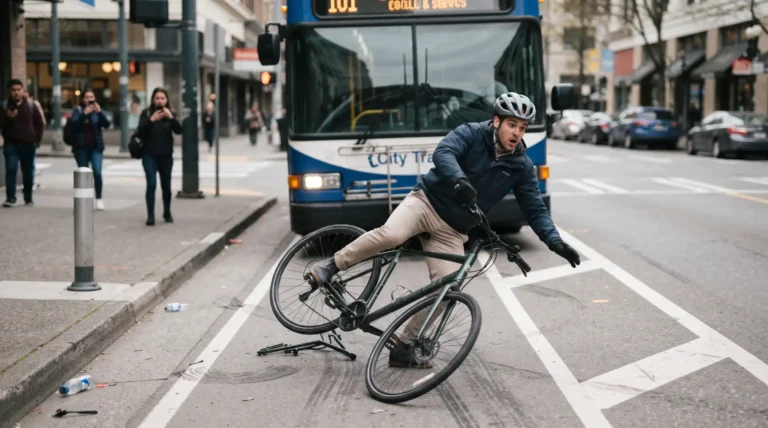
During school arrival and dismissal, streets can become crowded with parents dropping children off, school buses loading and unloading students, pedestrians crossing roads, teachers directing traffic, and cyclists traveling through intersections. Vehicles may be turning into parking lots or stopping unexpectedly along the curb. A child riding a bicycle can suddenly find themselves surrounded by moving vehicles.
When a child is struck by a vehicle, the physical and emotional consequences can be substantial. Children may suffer broken bones, concussions, traumatic brain injuries, spinal injuries, internal injuries, cuts, fractures, or other serious harm. Some injuries may require extensive medical treatment and may affect the child’s education, sports participation, social activities, and daily life.
The legal consequences can also be complicated.
Parents may need to determine who caused the crash, whether the driver was negligent, whether a dangerous roadway condition contributed to the collision, whether another party may be responsible, and what insurance coverage may be available.
A child’s age can also matter when determining whether the child’s actions contributed to an accident. The legal rules surrounding minors vary from state to state, meaning parents should not assume that the same standards apply in every part of the country.
This guide explains what parents should know about child bicycle accidents in school zones, including common causes, potential liability, evidence, insurance claims, medical documentation, and legal considerations.
Why School-Zone Bicycle Safety Deserves Special Attention
School zones are unlike ordinary sections of roadway.
Traffic patterns can change dramatically during the morning and afternoon. A road that is relatively quiet at 7 a.m. may become heavily congested shortly before classes begin. Vehicles may stop, merge, turn, reverse, or change lanes within a short distance.
Children may also enter the roadway from multiple directions.
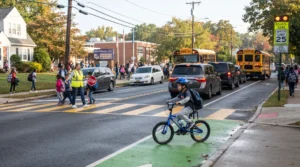
A cyclist could be traveling along a designated bike lane while another child walks toward a crosswalk. A parent may be pulling out of a parking area while a school bus is stopping nearby. A driver may be searching for a place to park while pedestrians are crossing.
These overlapping activities create numerous opportunities for a collision.
The National Highway Traffic Safety Administration provides bicycle safety guidance specifically addressing motorists, bicyclists, children, helmets, visibility, and safe roadway behavior. NHTSA emphasizes that motorists should remain alert for bicyclists and take appropriate precautions when driving around them. (NHTSA Bicycle Safety)
For children, the risks can be even greater because young cyclists may have less experience interpreting traffic situations.
A child may know basic traffic rules but still have difficulty estimating how quickly a vehicle is approaching. They may also assume that a driver has seen them simply because they are visible.
Unfortunately, being visible does not guarantee that a distracted or inattentive driver will react appropriately.
How Many Bicyclists Are Injured in the United States?
Bicycle injuries remain a significant public safety issue throughout the United States.
NHTSA reported 1,103 bicyclists killed in traffic crashes in 2024, along with an estimated 52,887 bicyclists injured. These figures demonstrate that bicycle collisions remain an important roadway safety concern. (NHTSA Bicycle Safety)
The Centers for Disease Control and Prevention also reports that bicyclists suffer a substantial number of injuries every year. According to the CDC, approximately 120,000 people visit emergency departments annually because of nonfatal bicycle crash-related injuries. (CDC Bicycle Safety)
Children and teenagers represent a particularly important group within bicycle injury statistics.
Research examining cyclist injuries found that children and adolescents under 20 represented a substantial percentage of bicycle-related injuries. Young riders may have less experience with traffic patterns and may be less capable of identifying dangerous situations before they develop.
That is one reason school-zone safety programs often focus on a combination of driver awareness, child education, traffic enforcement, roadway design, and parental supervision.
Common Causes of Child Bicycle Accidents in School Zones
A school-zone bicycle accident can have one cause or several contributing causes.
One of the most common concerns is driver inattention.
A driver may be looking at a smartphone, adjusting a navigation system, talking to passengers, eating, searching for a parking space, or simply failing to look carefully before proceeding through an intersection.
A moment of distraction can be enough to cause a collision with a child cyclist.
Failure to Yield
Drivers may also fail to yield to cyclists when required.
For example, a vehicle may turn across a bicycle lane while the cyclist is traveling straight through an intersection. The driver may look for approaching vehicles but fail to notice the bicycle.
This type of collision can be especially dangerous because the child may have very little time to react.
Speeding
Speed is another major factor.
A vehicle traveling quickly through a school zone has less time to respond when a child enters the roadway. Even if a driver remains below the posted speed limit, driving too fast for traffic, weather, visibility, or congestion can increase the danger.
The severity of a collision can also increase as vehicle speed increases.
Failure to Stop
Some school-zone accidents happen when drivers fail to stop at stop signs, red lights, marked crossings, or other traffic controls.
A child may legally enter an intersection believing that vehicles are required to stop, only to encounter a driver who does not comply.
Unsafe Turns
Turning vehicles can create another significant risk.
A driver making a right turn may focus on pedestrians crossing from one direction while failing to notice a child cyclist traveling along a bike lane.
Left turns can also create conflicts when a driver concentrates on oncoming traffic and fails to recognize a cyclist entering the intersection.
Vehicles Backing Up
School parking areas can be particularly hazardous.
A driver reversing out of a parking space or driveway may have limited visibility. A young cyclist approaching from behind the vehicle may not be visible in the driver’s mirrors or blind spots.
This is one reason drivers should exercise particular caution when backing up near schools, playgrounds, residential streets, and other areas where children are present.
Distracted Driving Can Put Young Cyclists at Risk
Distracted driving deserves special attention because children can be difficult for drivers to anticipate.
A driver who looks away from the roadway for only a few seconds can travel a considerable distance without seeing what is happening ahead.
A cyclist who was clearly visible moments earlier may suddenly be directly in the vehicle’s path.
Smartphones are an especially serious distraction, but distracted driving is not limited to texting.
Drivers can also become distracted by passengers, food, entertainment systems, navigation devices, pets, or other activities inside the vehicle.
If distraction is suspected after a bicycle accident, evidence may include witness statements, surveillance footage, dashcam recordings, police observations, and other available information.
Parents should avoid attempting to investigate another person’s private phone records themselves. Depending on the circumstances, legal procedures may be necessary to obtain certain records.
School-Zone Road Design Can Contribute to Bicycle Crashes
Not every accident is caused solely by driver behavior.
The design and condition of the roadway can also affect bicycle safety.
Some schools have protected bicycle lanes, dedicated crossings, traffic-calming measures, sidewalks, crossing guards, and clearly marked routes.
Others may have bicycle lanes that suddenly disappear at intersections or force cyclists into traffic.
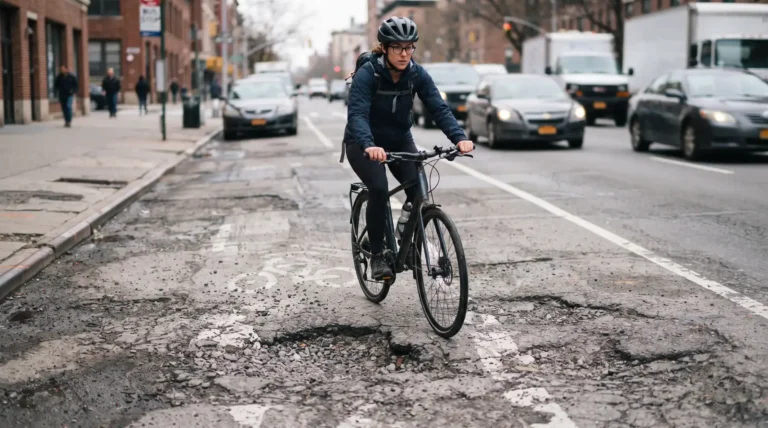
Potential roadway hazards include poorly designed intersections, faded lane markings, inadequate lighting, blocked sight lines, potholes, debris, confusing signs, construction zones, and improperly placed barriers.
For a child cyclist, a confusing roadway can create an especially difficult situation.
A young rider may follow the bicycle lane only to discover that it abruptly ends near a busy intersection. The child may then have to merge with traffic without fully understanding how vehicles around them are expected to respond.
The Federal Highway Administration and other transportation agencies have promoted Safe Routes to School programs that combine infrastructure, education, enforcement, and community involvement to improve conditions for children traveling to and from school.
NHTSA describes Safe Routes to School as a comprehensive approach involving children, parents, school personnel, community members, law enforcement, and transportation professionals. (NHTSA Safe Routes to School)
If a roadway condition contributed to a child’s accident, it may be important to determine who designed, controlled, maintained, or modified the area.
Who May Be Liable for a Child Bicycle Accident?
Determining who is legally responsible is one of the most important parts of an accident investigation.
In many cases, the driver may be responsible if negligent driving caused the collision.
For example, a driver who was speeding, distracted, failed to yield, ran a traffic signal, or made an unsafe turn could potentially be liable for injuries caused by the crash.
However, there can be more than one potentially responsible party.
Depending on the circumstances, a case could involve a property owner, construction company, school-related entity, transportation contractor, vehicle owner, or government agency.
The applicable law depends on the state.
This is particularly important when a roadway or public facility may be involved. Claims against government entities can have special procedural requirements and shorter deadlines than ordinary personal injury claims in some jurisdictions.
Parents should therefore avoid assuming that a school, city, county, contractor, or other organization is automatically responsible simply because the accident happened near its property.
A legal investigation must establish the connection between the party’s conduct or responsibility and the child’s injury.
Can a Driver Be Responsible Even If the Child Made a Mistake?
Potentially, yes.
Accidents are not always caused by one person’s actions.
Suppose a child unexpectedly moves outside a designated bicycle lane and a driver strikes the bicycle. The driver may argue that the child’s movement caused the accident.
However, investigators may still need to determine whether the driver was speeding, distracted, following too closely, or otherwise failed to react appropriately.
The presence of a possible mistake by the cyclist does not necessarily end the inquiry.
Depending on the state, comparative negligence or similar legal principles may be used to determine how responsibility is divided.
The rules vary significantly across the United States.
Does a Child’s Age Affect Liability?
A child’s age can be highly relevant.
Children generally have different levels of judgment and experience depending on their age.
A six-year-old cannot reasonably be expected to understand traffic in exactly the same way as a sixteen-year-old.
State law may apply different standards when determining whether a child acted negligently.
Courts may consider factors such as the child’s age, experience, circumstances of the accident, and the type of conduct involved.
This means an insurance company’s statement that a child “should have known better” should not necessarily be accepted without examining the actual circumstances.
Parents should also avoid allowing an insurance adjuster’s initial assessment to become the only version of what happened.
An independent investigation may reveal additional evidence.
What Happens When an Insurance Company Blames the Child?
Insurance companies investigate claims because they have a financial interest in determining whether their insured is liable.
If the facts are disputed, an insurer may attempt to argue that the child cyclist caused or contributed to the collision.
For example, the insurer might claim that the child:
- Entered the roadway unexpectedly.
- Failed to stop.
- Was riding in the wrong location.
- Was not paying attention.
- Failed to use required equipment.
But an insurance company’s position is not the same thing as a court’s final determination of liability.
The evidence should be examined as a whole.
Your site’s article Biker Bias: Why Insurance Companies Blame Cyclists and How a Lawyer Fights Back would be an excellent internal link here because it expands on disputes between injured cyclists and insurers.
When a child is involved, parents should be especially careful about giving recorded statements or accepting a settlement before understanding the full nature of the injury.
What Parents Should Do Immediately After a Child Bicycle Accident
The first priority should always be the child’s health.
If a child has been struck by a vehicle or suffered a significant fall, parents should obtain appropriate medical care.
Emergency medical treatment may be necessary even when the child initially appears calm or says that they feel fine.
Children may not always be able to accurately describe their symptoms immediately after a traumatic event.
Once the child is safe, parents should begin preserving information about the accident.
If possible, photographs should be taken of the accident location, bicycle, helmet, vehicle, roadway markings, signs, traffic signals, crosswalks, and surrounding area.
Witness information should also be collected.
Parents should record the names and contact information of people who saw the accident, if available.
The responding police agency should also be documented, along with any report or incident number.
Your existing article What to Do Immediately After a Bicycle Accident can be linked here as a detailed resource for readers.
Preserve the Bicycle, Helmet, and Other Physical Evidence
The child’s bicycle may contain important evidence about how the accident happened.
Parents should photograph the bicycle before repairing it and preserve damaged components whenever practical.
The helmet should also be preserved.
If the helmet was damaged during the crash, it may provide useful information about the impact.
Other items can also be relevant, including:
- Clothing worn during the collision
- Bicycle lights
- Reflectors
- Bicycle cameras
- Backpacks
- Electronic devices
- Safety equipment
Do not throw away damaged equipment simply because it appears unusable.
In a disputed case, physical evidence can help accident investigators reconstruct what happened.
Why Accident-Scene Photographs Matter
A photograph of a damaged bicycle is useful, but it may not tell the complete story.
The surrounding roadway can be equally important.
Parents should try to document the larger environment, including the intersection, traffic signals, bicycle lanes, crosswalks, stop signs, school-zone signs, parked vehicles, construction barriers, and potential obstructions.
A wide photograph can show how the road was configured.
Closer photographs can show details such as faded markings, damaged pavement, debris, or blocked signs.
If the accident occurred at a school entrance, photographs should also document where vehicles typically enter and exit the property.
Conditions can change after an accident, so timely documentation can be valuable.
Surveillance Video Can Be Critical
Many school zones and surrounding businesses have security cameras.
A nearby store, gas station, apartment complex, school building, traffic camera, parking lot, or residential property may have captured part of the accident.
Video can potentially establish:
- The direction of travel of the bicycle.
- The speed or movement of the vehicle.
- Whether the driver stopped.
- Whether a traffic signal changed.
- Whether the child was visible.
- Whether another vehicle blocked the driver’s view.
- What happened immediately before the collision.
Parents should identify potential cameras as quickly as possible.
Some surveillance systems automatically delete older recordings after a limited period.
Your article How to Gather Evidence After a Bicycle Accident can be linked in this section to provide readers with a deeper explanation of evidence preservation.
Medical Documentation Is Essential
Medical treatment is important for both the child’s health and the documentation of an injury claim.
Parents should maintain records of emergency room visits, physician appointments, imaging studies, prescriptions, physical therapy, specialist appointments, rehabilitation, and other accident-related treatment.
Parents should also document how the injury affects the child’s everyday life.
For example, a child may miss school, be unable to participate in sports, require help with ordinary activities, or experience difficulty sleeping or concentrating.
These effects can be important when evaluating the overall impact of an injury.
Your website’s article The Importance of Medical Documentation After a Bicycle Accident would be a natural internal link in this section.
Common Injuries From Child Bicycle Accidents
A bicycle collision can cause relatively minor injuries or life-changing trauma.
Broken wrists, arms, legs, shoulders, and collarbones are common concerns because children may instinctively extend their arms when falling.
Head injuries are another major concern.
Even when a child wears a helmet, a collision can result in a concussion or other brain injury.
Symptoms may include headaches, dizziness, nausea, confusion, sensitivity to light, unusual fatigue, changes in behavior, or difficulty concentrating.
Parents should follow medical advice after an accident and seek emergency treatment when symptoms warrant it.
More serious crashes can also cause spinal injuries, internal injuries, fractures, nerve damage, dental injuries, and permanent scarring.
The severity of the injury can have a significant effect on the potential value and complexity of a claim.
How a Serious Injury Can Affect a Child’s Future
A child’s injury is not always limited to immediate medical bills.
A serious injury can affect school performance, sports participation, hobbies, social activities, and emotional well-being.
A child with a significant traumatic brain injury, for example, may require long-term treatment or educational support.
A spinal injury may require rehabilitation or future medical care.
A serious orthopedic injury could interfere with sports and physical activities for months or years.
When evaluating a serious injury claim, it may therefore be necessary to consider both current and future consequences.
Parents should not assume that a claim can be valued solely by adding the first emergency-room bill and the cost of repairing the bicycle.
What Compensation May Be Available?
If another party is legally responsible for the accident, compensation may potentially be available for certain losses.
Depending on the state and circumstances, these losses can include medical expenses, rehabilitation, future medical treatment, bicycle or property damage, and other economic losses.
Non-economic damages may also be available in appropriate cases.
These can potentially include pain and suffering and other consequences associated with the injury.
The precise categories and calculation of damages vary from state to state.
Claims involving children can also involve special rules regarding settlements, court approval, guardianship, and the handling of settlement funds.
Parents should obtain jurisdiction-specific legal advice before accepting a significant settlement on behalf of an injured child.
Can a School Be Held Responsible?
The fact that an accident occurred near a school does not automatically make the school legally responsible.
The specific location and circumstances matter.
If the accident happened on a public road, the primary investigation may focus on the driver and roadway conditions.
If the accident occurred on school property, different questions may arise regarding property maintenance, traffic control, supervision, or other responsibilities.
If a public school or government entity is involved, special governmental liability rules may apply.
If a private school is involved, the applicable legal standards may be different.
Parents should document exactly where the accident happened.
A few feet can sometimes make a significant difference in determining which entity controlled the property or roadway.
What If a School Bus Is Involved?
School buses create another category of bicycle accident.
A child cyclist could be struck by a school bus, collide with a bus, or be involved in a crash with another vehicle near a school bus stop.
A school bus may also obstruct the view of other drivers.
When a school bus is involved, investigators may need to examine the bus driver, bus company, school district, vehicle owner, maintenance records, route information, and insurance coverage.
NHTSA has emphasized the importance of safety around school transportation and school zones, particularly as children return to school and pedestrian and bicycle activity increases. (NHTSA School Transportation Safety)
Commercial and school transportation cases can become complicated quickly, particularly when multiple entities are involved.
E-Bikes and Young Cyclists
Electric bicycles have added another important issue for parents.
E-bikes are increasingly popular across the United States, including among teenagers and younger riders.
However, e-bikes can differ substantially from traditional bicycles.
Some can travel faster, weigh more, and provide motor assistance that changes how quickly the bicycle accelerates.
State and local laws governing e-bikes can also differ.
Parents should understand the rules applicable to the particular class of e-bike being used.
The American College of Surgeons Committee on Trauma has raised concerns about increasing e-bike injuries among children and adolescents and has supported stronger safety measures involving age requirements, helmet use, education, and training. (American College of Surgeons)
If an e-bike is involved in a school-zone accident, investigators may also examine its classification, speed capability, modifications, equipment, and condition.
Child Bicycle Accidents and Comparative Negligence
Comparative negligence can become important when more than one person may have contributed to an accident.
For example, suppose a driver was speeding but the child cyclist also failed to follow a traffic signal.
Depending on the state’s laws, responsibility could potentially be divided between the parties.
The effect of that division differs across jurisdictions.
Some states reduce compensation according to a person’s percentage of fault, while other states have additional restrictions on recovery depending on the amount of fault assigned.
Parents should therefore avoid assuming that a child being partially blamed automatically eliminates the possibility of recovering compensation.
The actual legal standard must be determined under the law of the state where the accident occurred.
This is an ideal location to internally link to your existing article:
The Role of Comparative Negligence in Bicycle Accident Claims
That article can provide readers with additional information without requiring this post to duplicate the entire subject.
Why Witnesses Matter in Child Bicycle Accident Cases
Children may not be able to provide a complete account of a collision.
A young child may remember only certain moments.
An independent witness can sometimes provide valuable information about what happened.
Witnesses may have seen the vehicle before impact, observed whether the driver was using a phone, noticed a traffic signal, or watched the child approach the intersection.
Parents should collect witness contact information when possible.
They should avoid pressuring children or witnesses to change their accounts.
The goal should be to preserve what each person independently remembers.
What If the Driver Leaves the Scene?
A hit-and-run can make an already difficult situation even more complicated.
Parents should report the collision to law enforcement.
Witnesses may remember the vehicle’s color, make, model, license plate, direction of travel, or other identifying information.
Nearby cameras may also capture the vehicle.
If the driver is never identified, insurance coverage may become important.
Depending on the family’s insurance policy and state law, uninsured motorist coverage may potentially provide protection after a hit-and-run.
However, coverage varies and should be reviewed carefully.
Parents should not assume that an unidentified driver means there are no possible sources of compensation.
What Parents Should Know About Insurance Settlements
Insurance companies may contact parents relatively quickly after a crash.
Parents should remember that an insurer’s goal is to resolve the claim according to the policy and applicable law. An early settlement offer may not reflect the child’s long-term medical needs.
This is particularly important when the child’s diagnosis is still developing.
Some injuries become clearer only after additional medical evaluations.
Parents should understand the child’s prognosis before making decisions about a significant settlement.
Settlement procedures for minors can also differ from ordinary adult injury claims.
Some jurisdictions may require court approval or other safeguards before a minor’s settlement becomes final.
For a serious injury, obtaining advice from an attorney familiar with the applicable state law can help parents understand these issues.
Statutes of Limitations and Claims Involving Children
Every state has deadlines for filing different types of legal claims.
These deadlines are known as statutes of limitations.
Claims involving minors can be subject to special rules, but parents should never assume that the deadline is automatically extended until the child turns 18.
The rules can differ depending on the state, type of claim, responsible party, and circumstances.
Claims involving government entities may also have separate notice or administrative requirements.
Because missing a legal deadline can potentially prevent a family from pursuing a claim, parents should obtain jurisdiction-specific advice promptly after a serious accident.
How Parents Can Help Prevent School-Zone Bicycle Crashes
While legal rights are important after an accident, prevention remains the best outcome.
Parents can begin by practicing the school route with their child.
Instead of simply choosing the shortest route, parents can look for streets with lower traffic speeds, protected bicycle infrastructure, fewer complicated intersections, better visibility, and safer crossings.
Children should understand how to approach intersections, watch for turning vehicles, obey applicable traffic signals, and remain alert around driveways and parking lots.
Parents should also check that the child’s bicycle fits properly and is mechanically safe.
Brakes, tires, lights, reflectors, and other equipment should be checked regularly.
NHTSA recommends properly fitted bicycle helmets for children and provides safety information for families. (NHTSA Bicycle Safety)
A helmet cannot prevent every injury, but properly wearing one is an important part of bicycle safety.
Teaching Children to Watch for Turning Vehicles
One of the most useful safety lessons parents can teach young cyclists is to watch for turning vehicles.
A green light does not mean a cyclist should stop paying attention.
A driver turning across the cyclist’s path may fail to see the bicycle.
Children should learn to look for vehicle movement and make sure it is safe to proceed.
Parents can practice this skill on the actual school route.
They can point out driveways, parking lots, intersections, and locations where vehicles frequently turn.
Teaching children to anticipate potential conflicts can help them recognize dangerous situations earlier.
Safe Routes to School and Community Improvements
Parents can also become involved in local safety initiatives.
Safe Routes to School programs are designed to encourage children to walk and bicycle while addressing infrastructure and behavioral safety concerns.
NHTSA describes these programs as involving education, encouragement, engineering, enforcement, and community participation. (NHTSA Safe Routes to School)
Parents who notice a dangerous school-zone intersection can report the concern to the appropriate local transportation authority.
Issues such as missing bicycle lanes, inadequate crossings, blocked signs, poor lighting, confusing traffic patterns, and dangerous vehicle speeds can sometimes be addressed through community safety programs.
Documentation can make those requests more effective.
Photographs, dates, times, traffic observations, and descriptions of near-miss incidents can help transportation officials understand the problem.
When Should Parents Contact a Bicycle Accident Lawyer?
A minor accident involving no injury and no disputed responsibility may not require extensive legal intervention.
However, parents should consider seeking legal guidance when their child suffers a serious injury, the driver disputes responsibility, an insurance company blames the child, multiple parties may be liable, a government entity may be involved, or the child is expected to require substantial future medical treatment.
An attorney can investigate the circumstances, preserve evidence, communicate with insurance companies, identify potentially responsible parties, and explain the legal options available under the applicable state law.
A lawyer can also help parents understand how the child’s age affects the claim and whether special procedures apply to a minor’s settlement.
Your existing article What to Expect When Filing a Bicycle Accident Claim is an appropriate internal link for readers who want to understand the broader claims process.
How a Bicycle Accident Lawyer May Investigate the Crash
A serious child bicycle accident can require more investigation than simply reviewing a police report.
An attorney may examine photographs, witness statements, vehicle damage, bicycle damage, medical records, surveillance footage, traffic signals, roadway design, and other evidence.
In complex cases, accident reconstruction professionals may be used to analyze vehicle speeds, impact locations, visibility, stopping distances, and the positions of the bicycle and vehicle.
An attorney may also investigate whether additional parties have relevant insurance coverage.
For example, the vehicle driver may have automobile insurance, while another party could have commercial or property insurance.
The purpose of the investigation is to establish what happened and identify the parties who may legally be responsible.
Frequently Asked Questions
What should I do if my child is hit by a car while riding a bicycle?
Make the child’s health the first priority. Seek medical attention when appropriate, contact emergency services if necessary, report the accident, preserve evidence, photograph the scene, identify witnesses, and keep medical records and accident-related documentation.
Can a child be held responsible for a bicycle accident?
A child can potentially be accused of contributing to an accident, but the legal standards governing children’s conduct vary by state. The child’s age, experience, actions, the driver’s conduct, roadway conditions, and other circumstances may all matter.
Can parents file a bicycle accident claim for an injured child?
Potentially. Claims involving minors are generally handled by a parent or legal representative, but procedures differ between states. Some settlements involving minors may require court approval or other legal safeguards.
What if the driver says my child caused the accident?
The driver’s statement is only one piece of evidence. Parents should preserve photographs, witness information, video footage, police reports, medical documentation, and other evidence that can help establish what actually happened.
What if the accident happened directly outside a school?
The location does not automatically determine liability. The investigation may need to examine the driver, roadway, school property, traffic controls, construction activity, and other circumstances.
Can a school be responsible for a child’s bicycle accident?
Possibly, depending on the circumstances. A school is not automatically liable simply because an accident occurs nearby. The location, property ownership, maintenance responsibilities, conduct of employees, and applicable state law must be considered.
What if a government agency maintains the road?
A claim against a city, county, state, or other government entity can involve special procedures and deadlines. Parents should obtain legal advice promptly rather than assuming ordinary personal injury rules apply.
Does my child need to have been wearing a helmet to bring a claim?
Helmet use and responsibility for causing a crash are separate issues, although helmet use may become relevant to particular injury or damages questions depending on state law. A driver who causes a collision may still potentially be responsible for the injuries caused by that collision.
What if my child’s bicycle was an e-bike?
The investigation may need to consider the e-bike’s classification, speed capability, equipment, modifications, applicable state and local regulations, and the child’s age. E-bike rules differ throughout the United States.
What if the driver leaves the scene?
Report the collision to law enforcement. Witnesses, surveillance footage, traffic cameras, vehicle descriptions, and insurance coverage may help identify the driver or provide another potential source of compensation.
How long do I have to bring a claim?
The deadline depends on the state, type of claim, age of the injured child, responsible party, and other circumstances. Government claims may involve additional requirements. Parents should not assume they can wait until the child turns 18 before taking action.